
Hollywood’s “Stealing Isn’t Innovation” Moment
Why a new artist coalition is forcing AI training out of the shadows
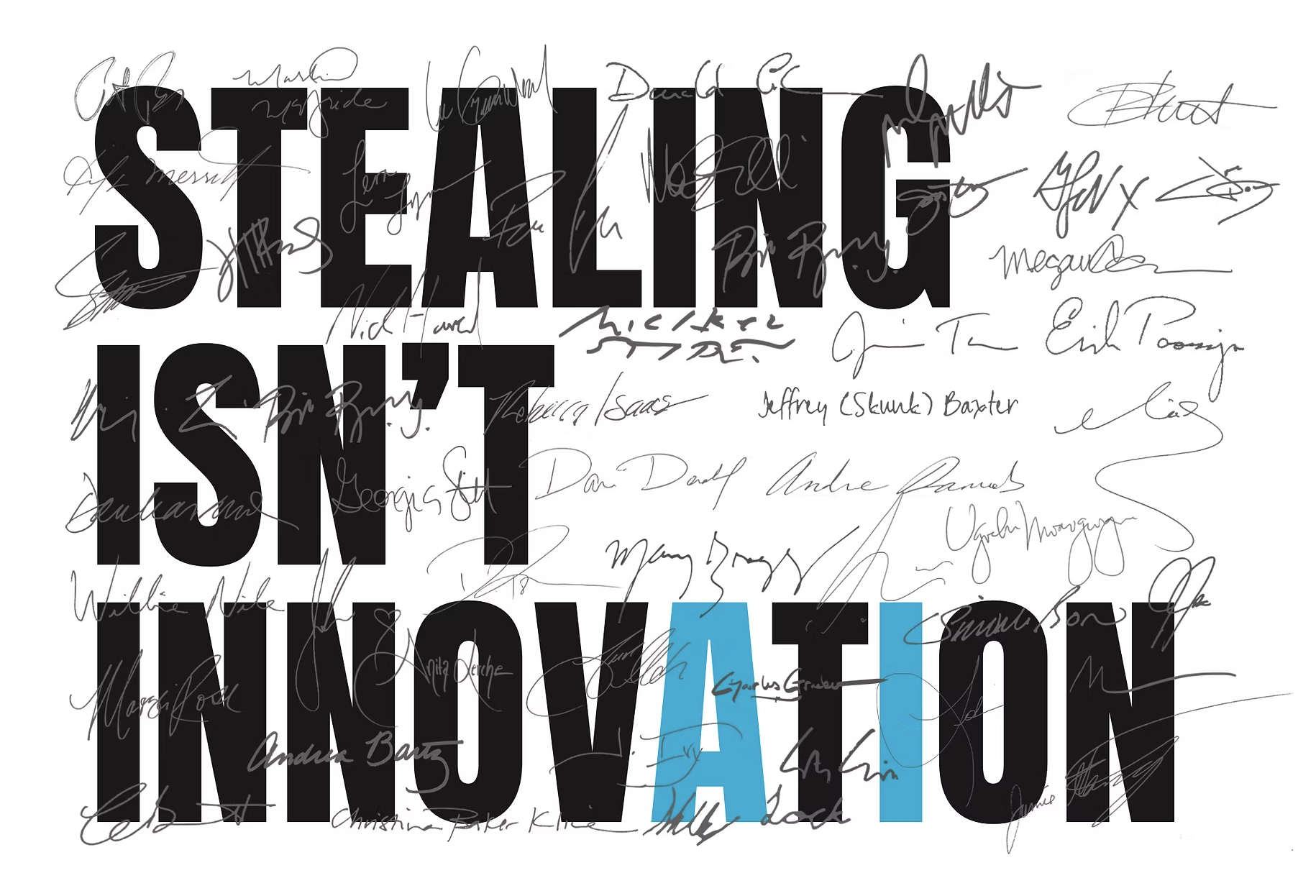
Campaign image from the “Stealing Isn’t Innovation” artist coalition. Used here for editorial commentary. https://www.stealingisntinnovation.com/
This week, more than 800 artists and creatives — including Scarlett Johansson, Kristen Bell, Vince Gilligan, and members of R.E.M. — publicly aligned behind a blunt message to the tech industry: “Stealing Isn’t Innovation.”
The campaign, launched as an open letter and public advocacy effort, calls on AI companies to stop training models on copyrighted works without consent and compensation. Unlike earlier, fragmented protests, this one feels coordinated, cross-disciplinary, and deliberately political. Actors, writers, musicians, and visual artists are presenting a united front — not against AI itself, but against how it has been built.
That distinction matters. The letter does not reject generative technology outright. Instead, it frames the issue as an economic and moral failure: an entire creative economy was absorbed into training datasets without permission, and the burden of proof has been shifted onto creators to object after the fact.
Hollywood has heard versions of this argument before, but never at this scale. What’s different now is timing. The campaign arrives as studios, streamers, and agencies are quietly normalizing AI workflows across production, marketing, and localization. The creative class sees the writing on the wall — and is trying to intervene before “training without consent” becomes an accepted historical fact.
The industry response has been cautious. No major studio has publicly endorsed the campaign, but several executives privately acknowledged that the letter reflects a growing discomfort inside Hollywood. The problem is leverage. AI companies have already trained their models. The question is whether future versions will require licensing — and who pays for it.
For policymakers, the campaign adds urgency to an already crowded regulatory calendar. Copyright law was never designed for probabilistic models trained on massive corpora. Courts have so far avoided decisive rulings, leaving a vacuum that creators are now trying to fill with public pressure.
What’s striking is how little this resembles a traditional labor fight. There are no picket lines, no contract deadlines, no single counterparty. Instead, the campaign targets legitimacy. It seeks to make unlicensed training socially indefensible, even if it remains legally ambiguous.
Hollywood understands that move well. Cultural stigma often arrives before regulation. And once it does, companies adapt quickly.
Whether “Stealing Isn’t Innovation” forces real licensing frameworks remains to be seen. But it has already accomplished something meaningful: it has made AI training practices a mainstream conversation again, just as the industry seemed ready to move on.