
Tribeca's AI Film Premiere Forces Hollywood to Separate Technology From Storytelling
Dreams of Violets, the first AI-generated live-action feature accepted into a major film festival, arrived at Tribeca with modest expectations but sparked one of the industry's biggest creative debates of the summer.
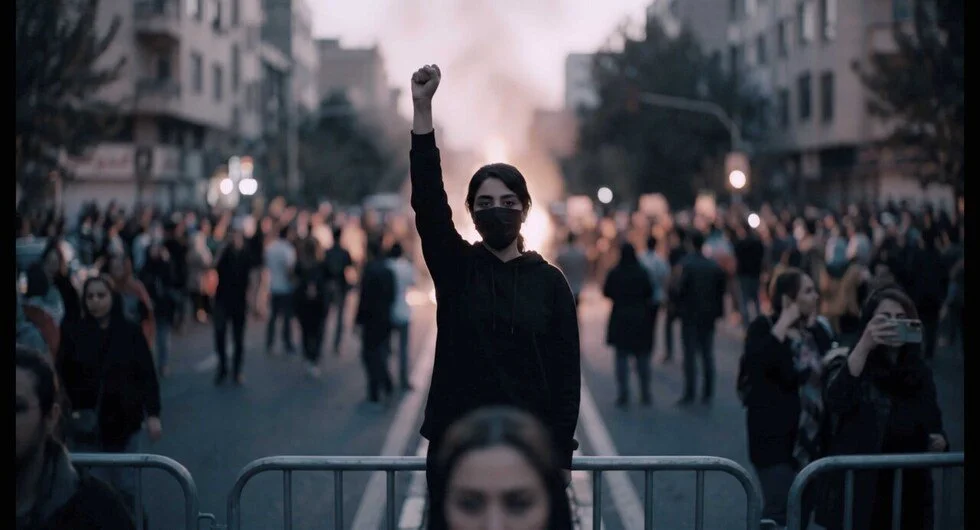
Image courtesy of Fountain 0 / Tribeca Festival
For years, conversations about artificial intelligence in filmmaking have focused on the technology itself—how quickly models are improving, whether AI will replace artists, and what legal protections Hollywood needs to preserve creative work. At this year's Tribeca Festival, the discussion shifted to something much simpler: could an AI-assisted film stand on its own as cinema?
That question arrived with Dreams of Violets, a 75-minute feature directed by brothers Ash and Pooya Koosha, which premiered at Tribeca on June 10 after becoming the first AI-generated live-action feature accepted into the festival's official lineup. Produced for approximately $2,000, the film dramatizes the Iranian government's violent crackdown on protesters in January 2026 through fictional characters inspired by eyewitness testimony and journalistic reporting.
Its budget alone would have made headlines.
Independent features shown at major festivals routinely cost hundreds of thousands—or several million—dollars to produce. By comparison, Dreams of Violets relied on a combination of commercially available AI tools, including Kling AI for video generation, Google's Nano Banana for image creation and Anthropic's Claude for language editing, according to the filmmakers.
But the technology was not the festival's primary talking point.
Instead, industry conversations centered on whether AI had enabled a story that otherwise would never have reached the screen.
Speaking to Reuters during the festival, Ash Koosha argued that the film was never intended as a demonstration of artificial intelligence. He described AI as a practical production solution rather than the subject of the movie itself, saying the story could not realistically have been produced through traditional filmmaking because of financial and logistical constraints. The filmmakers emphasized that they were interested in creating new creative jobs around AI workflows rather than eliminating existing ones.
That distinction resonated with many filmmakers attending Tribeca.
For much of Hollywood's AI debate, generative technology has been discussed as a replacement for existing creative labor. Dreams of Violets presented a different case. The film did not argue that AI should replace conventional productions. Instead, it suggested that certain stories—particularly those involving inaccessible locations, political risk or extremely limited budgets—might become possible only because AI dramatically reduces production costs.
That argument is difficult for the industry to dismiss outright.
Hollywood has always celebrated independent filmmaking as a source of creative risk-taking. Yet the economics of independent production have become increasingly challenging. Financing has tightened, production costs remain elevated and distributors have become more selective. If AI allows filmmakers to produce projects that otherwise would never secure financing, the technology occupies a different space than the one envisioned in many studio labor disputes.
None of this eliminates legitimate concerns.
Questions surrounding training data, copyright, performer consent and employment remain unresolved. Festival acceptance also does not imply artistic endorsement of the production methods. Tribeca programmed the film because it believed the work contributed to an important cultural conversation, not because it declared AI the future of filmmaking.
Still, the symbolism matters.
Major film festivals have historically introduced audiences to new cinematic movements—from digital filmmaking to virtual production. By programming Dreams of Violets, Tribeca acknowledged that AI-assisted filmmaking has progressed beyond experimental demonstrations and into the realm of feature-length storytelling.
Whether audiences ultimately embrace these films remains uncertain.
But one thing became clear in New York this June: Hollywood's AI debate is beginning to move beyond questions of whether the technology exists. The more interesting question now is what kinds of stories become possible when the traditional barriers to production begin to disappear.